
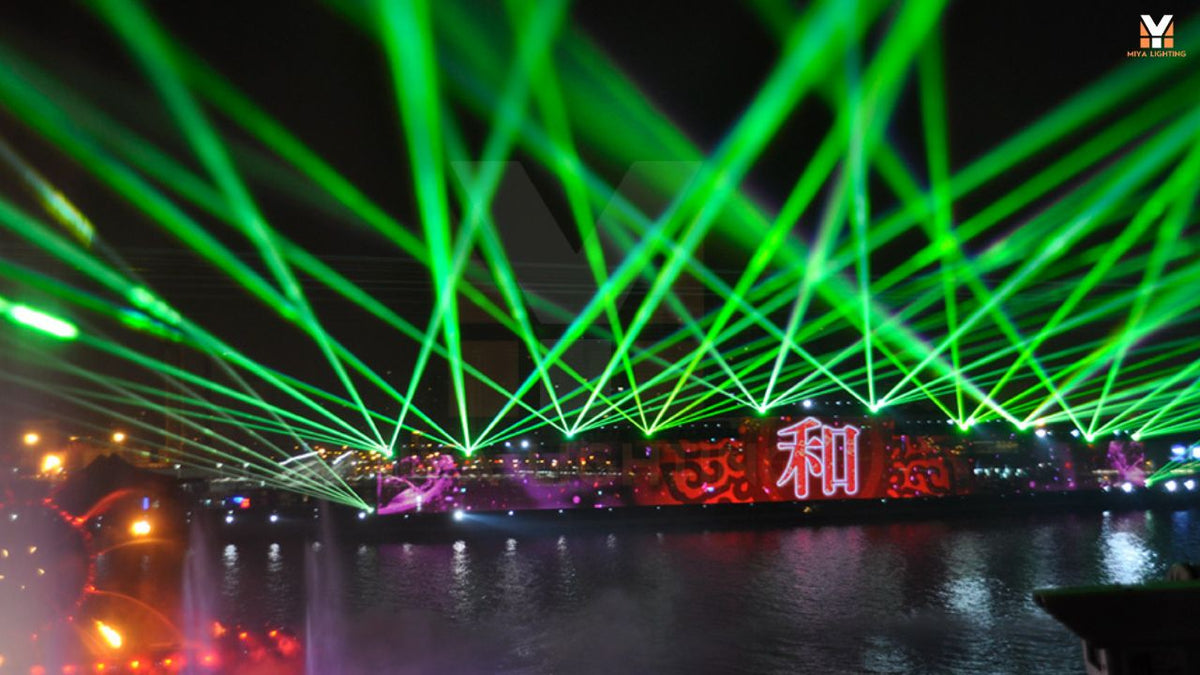
Lasers are everywhere in modern life, even when we don’t consciously notice them. From barcode scanners and laser printers to medical treatments and outdoor light shows, laser technology quietly shapes how we see, measure, cut, project, and entertain. Over the years, lasers have moved far beyond laboratories and factories and into everyday creative spaces—concerts, holiday displays, architectural lighting, and immersive events.
To understand why some lasers are better suited for certain applications than others, it helps to look at the five main types of lasers, how they work, and where they are commonly used. More importantly, it helps explain why modern laser lighting brands like MIYA Laser focus on specific laser technologies for stage, event, and outdoor projection.
Before diving into the different types, let’s briefly answer a foundational question.
What Is a Laser?
A laser is a device that produces a highly controlled beam of light. Unlike ordinary light, laser light is monochromatic (a specific wavelength or color), coherent (the light waves move in sync), and collimated (the beam stays narrow over long distances). This combination is what makes lasers so precise, intense, and visually striking.
Every laser system—regardless of type—relies on three core components: an energy source, a gain medium, and an optical resonator. The gain medium is what defines the type of laser, and it determines how the laser behaves in real-world applications.

Gas Lasers
Gas lasers were among the earliest laser technologies developed. They generate light by sending an electrical current through a gas, such as carbon dioxide, helium-neon, argon, or krypton. CO₂ lasers, in particular, are well known for industrial cutting and engraving, while helium-neon lasers are often used for alignment and measurement.
Although gas lasers are powerful and reliable, they tend to be bulky and less energy-efficient. For this reason, they are rarely used in modern decorative or entertainment lighting, especially where portability and compact design matter.

Solid-State Lasers
Solid-state lasers use a solid crystal or glass doped with rare-earth elements like neodymium or erbium as the gain medium. The famous ruby laser and Nd:YAG lasers fall into this category. These lasers are widely used in medical treatments, material processing, and scientific applications.
Solid-state lasers offer high output power and stability, but they often require complex cooling systems. In entertainment lighting, their role is mostly indirect, serving as the foundation for other laser technologies rather than being used directly in show projectors.
Fiber Lasers
Fiber lasers are a specialized form of solid-state laser where the gain medium is an optical fiber doped with rare-earth elements. Because the light is guided within the fiber, fiber lasers are extremely efficient, precise, and compact.
They dominate industrial applications such as laser cutting, welding, and marking. However, fiber lasers are generally optimized for invisible or near-infrared wavelengths, which limits their use in visible RGB laser light shows.

Liquid Lasers (Dye Lasers)
Liquid lasers, also known as dye lasers, use organic dye solutions as the gain medium. Their biggest advantage is tunability—they can produce a wide range of wavelengths by adjusting the dye composition.
Despite their flexibility, dye lasers are complex, require frequent maintenance, and are impractical for consumer or entertainment use. As a result, they are mainly found in research and specialized medical applications rather than lighting design.

Semiconductor Lasers (Laser Diodes)
Semiconductor lasers—commonly called laser diodes—are the backbone of modern laser lighting. These lasers generate light using semiconductor materials at a PN junction, converting electrical energy directly into laser light.
Laser diodes are compact, energy-efficient, and highly reliable. They are used in everything from laser pointers and Blu-ray players to professional laser light projectors. Most importantly, laser diodes can be precisely controlled and combined to produce vivid RGB color output, making them ideal for stage and event lighting.
This is where MIYA Laser focuses its expertise.

How MIYA Applies Laser Technology in Real-World Lighting
MIYA Laser builds its products around high-quality semiconductor laser diodes, chosen specifically for stability, color accuracy, and long-term performance. Instead of pursuing theoretical extremes, MIYA designs laser systems for real environments—clubs, outdoor events, architectural installations, and seasonal displays.
A strong example of this approach is the MIYA MY2-A Series Outdoor Stage Laser Projector.
The MY2-A Series: Turning Laser Theory into Practical Results
The MY2-A Series is a professional RGB animation laser projector designed for users who want reliable outdoor performance without unnecessary complexity. Available in 3W, 5W, 8W, 10W, and 12W configurations, each model runs at 40Kpps scanning speed, allowing smooth animations, crisp text, and clean logo projection.
One of the biggest challenges in outdoor laser lighting is environmental exposure. Rain, humidity, dust, and temperature changes can quickly degrade standard fixtures. That’s why the MY2-A Series features an IP65 waterproof housing, making it suitable for long-term outdoor laser light shows in almost any weather.
Color performance is another area where laser diode quality matters. The MY2-A Series uses true RGB analog modulation, which allows smooth color blending rather than abrupt on-off color changes. This results in richer reds, cleaner greens, and deeper blues—especially noticeable in large-scale projections.
Control flexibility is equally important. Depending on the project, users may want quick setup or deep customization. The MY2-A Series supports DMX laser control, ILDA software integration, auto-run, sound modes, and LightELF app control on iOS and Android. Whether you’re programming a synchronized show or running a standalone holiday display, the system adapts easily.

Behind the scenes, MIYA integrates a professional cooling system and built-in safety features such as automatic laser shutoff if the signal is lost. These details may not be visible during a show, but they are critical for long-term reliability and peace of mind.
With free shipping in the USA, fast delivery, hassle-free warranty coverage, and lifetime technical support, the MY2-A Series reflects MIYA’s focus on practical value—not just specifications on paper.
Why Laser Types Still Matter
Understanding the different types of lasers helps explain why some lighting products perform better than others. While gas, solid-state, fiber, and liquid lasers each have their place, semiconductor laser diodes remain the most versatile and practical choice for modern laser lighting.
By building around this technology, MIYA Laser bridges the gap between advanced laser science and everyday creative use. Whether you’re planning a holiday projection, designing a club lighting setup, or installing permanent outdoor laser displays, knowing how laser types translate into performance helps you make smarter choices.
Lasers may come in many forms, but the right laser—designed with the right purpose—can transform any space into something unforgettable.

Leave a comment
This site is protected by hCaptcha and the hCaptcha Privacy Policy and Terms of Service apply.