
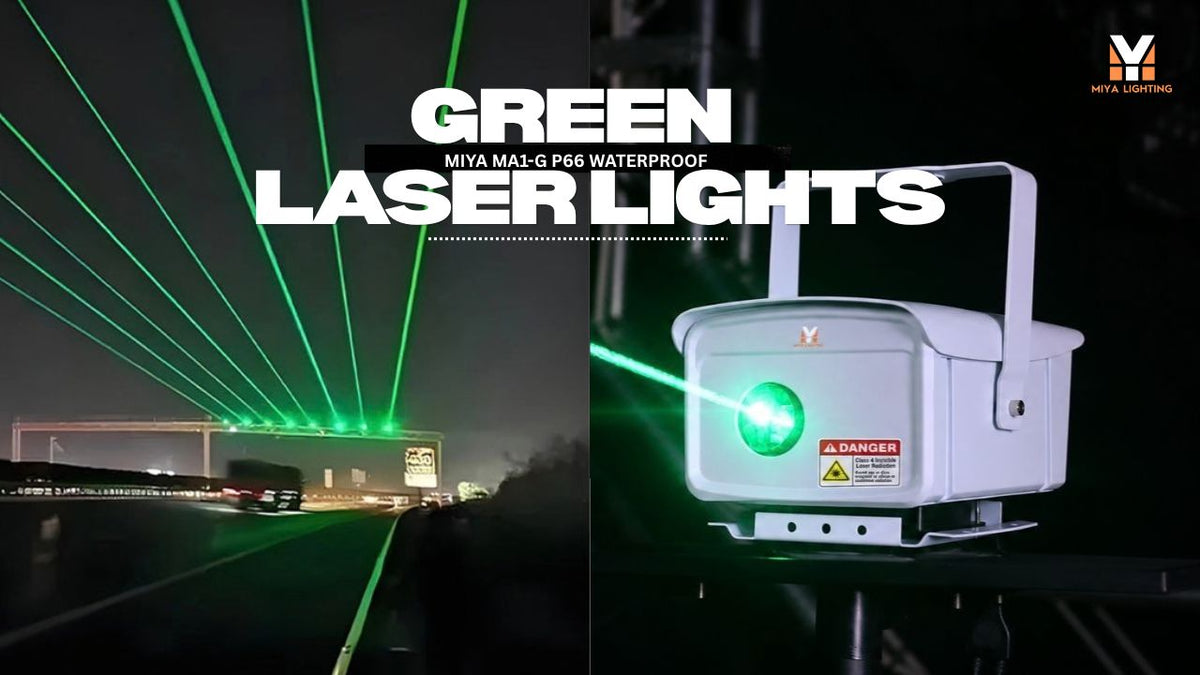
Roadside lighting has a difficult job. It needs to remain visible in an environment already filled with highway lights, storefront signs, vehicle headlights, parking lot fixtures, and conventional street lighting.
Most highway lighting is designed for a practical purpose: helping illuminate roads, intersections, ramps, and surrounding infrastructure. A commercial property beside a busy road has a different challenge. Hotels, restaurants, attractions, landscaped entrances, and event venues may want their property to stand out after dark without simply adding another row of conventional lights.
That’s where green laser lights can add something different.
Instead of functioning as a highway light or illuminating the road itself, a green laser projector can create a concentrated visual effect across a controlled landscape, tree line, building surface, or designated display area.
Used correctly, it can make a roadside property more noticeable to pedestrians and passersby while remaining separate from functional road lighting.
Green Laser Lighting Is Different from Highway Lighting
It’s important to understand the difference between a landscape laser and conventional highway street lights.
Traditional roadway fixtures are designed primarily for illumination. A road light or streetlight spreads usable light across pavement and surrounding areas so people can see the road environment.
Modern highway LED lights are commonly used for this purpose because they provide efficient, consistent illumination across transportation infrastructure.
A green landscape laser has a completely different job.
It creates a concentrated decorative visual effect rather than general roadway illumination.
Think of it this way:
Highway lighting → illuminates the roadway
Landscape lighting → illuminates trees, buildings, and property features
Green laser lighting → adds a concentrated visual effect to a controlled landscape or display area
The MIYA MA1-G belongs in the third category.
It should complement a property's existing outdoor lighting—not replace functional highway lights or streetlights.

Use the Landscape as the Projection Target
The most effective way to use a green laser near a road is to make the property itself the visual target.
For example, a hotel entrance may already have architectural lighting, pathway fixtures, and a nearby road side light. Adding more static fixtures may not create much visual separation from the surrounding environment.
Instead, a green laser effect can be directed toward a controlled tree canopy, landscaped slope, decorative wall, or other suitable feature within the property.
The result is a visual focal point that sits behind or beside the normal roadside environment.
This approach can work for:
- Hotel and resort entrances
- Restaurants near major roads
- Event venues
- Scenic attractions
- Commercial plazas
- Landscaped property entrances
- Entertainment destinations
The laser becomes part of the landscape—not part of the traffic lighting system.
Why Green Laser Effects Stand Out at Night
A typical road may already contain numerous lights on the highway, illuminated signs, parking lot fixtures, storefronts, and vehicle headlights.
Adding another static white fixture can easily disappear into that visual environment.
Movement changes the equation.
A controlled green laser effect moving across trees or another landscape surface introduces a visual element that looks different from ordinary lights on roads.
That distinction can make a commercial landscape more noticeable after dark.
It doesn’t mean the laser needs to be excessively bright or aggressive. In many applications, a controlled effect across a selected landscape feature creates more visual interest than simply adding more conventional lighting.

Green Laser vs. Highway LED Lights
A green laser projector and highway LED lights should not be considered competing products because they solve different problems.
LED roadway fixtures are designed to illuminate roads.
A green landscape laser is designed to create an effect.
If your project requires safer, more uniform pavement illumination, proper roadway or street lighting is the appropriate solution.
If the objective is to make a commercial landscape, attraction, or property entrance visually distinctive, a green laser can become an additional decorative layer.
This distinction is particularly important for properties located beside a brightly illuminated road.
The goal isn’t to overpower existing highway street lighting. It’s to create a different type of visual experience within the property.
Never Use a Green Laser as a Road Light
A roadside installation requires careful positioning.
A laser should not be aimed down a roadway, across traffic lanes, toward vehicle windshields, or directly at drivers. It should also be kept away from aircraft and other uncontrolled areas.
That means a green laser should never be installed as though it were a highway road light.
Instead, plan the installation around a controlled target: Projector → Landscape / Tree / Building → Defined Projection Area
Not: Projector → Road / Traffic / Driver
This is one of the most important differences between professional roadside landscape effects and conventional lighting on roads.
Visual impact should come from the landscape people see—not from directing laser output toward road users.

Combine Green Lasers with Traditional Roadside Lighting
The strongest commercial installations usually combine several types of lighting.
A property might use:
- Street and highway lighting for the surrounding road environment.
- Pathway lighting for pedestrians.
- Architectural lighting for the building.
- Landscape lighting for trees and gardens.
- Green laser effects for movement and visual identity.
This creates layers rather than forcing one fixture to perform every job.
For example, a roadside restaurant might use warm architectural lighting around the building, low-level lights along pedestrian paths, conventional outdoor fixtures around the parking area, and a green laser effect across a tree line behind the property.
The laser becomes the visual accent.
Where the MIYA MA1-G Fits
The MIYA MA1-G is designed for outdoor green laser effects rather than conventional roadway illumination.
It uses a 520±5nm green laser source and is available in 1W, 2W, and 3.6W configurations, allowing different output levels to be considered according to the target area, projection distance, ambient lighting, and desired visual effect.
The projector also uses an IP66-rated housing, an important consideration for equipment installed outdoors near roads, commercial entrances, landscaped properties, and attractions.
Control options include Auto, DMX512, and Master/Slave modes.
A single unit can provide a standalone effect, while multiple projectors can be coordinated for larger commercial landscapes.

Choose Power Based on the Property, Not the Highway
One common mistake is assuming that a property beside a larger road automatically needs the highest-powered projector.
It doesn’t.
Choosing between 1W, 2W, and 3.6W should depend on the actual installation:
Target size → Projection distance → Ambient light → Viewing position → Desired effect
A darker landscape may require less output than a property surrounded by bright signs and conventional highway lights.
Likewise, increasing laser power does not solve poor projector positioning.
Site planning matters just as much as output.
Roadside Lighting Should Build a Visual Identity
Good roadside landscape lighting isn’t about making everything brighter.
Traditional road lighting, streetlights, and motorway lighting already serve important functional purposes. A commercial property needs something different when the goal is visual identity.
Use conventional lighting where people need illumination. Use landscape fixtures to reveal trees, entrances, and architecture. Then use a green laser where you want a controlled visual effect that adds movement and catches attention.
That’s where the MIYA MA1-G green laser projector fits.
It isn’t a replacement for a highway light, streetlight, or functional roadway fixture. It is an outdoor visual-effect projector designed to help roadside landscapes, commercial properties, scenic areas, and attractions create a more distinctive nighttime presence.
When the laser is aimed at the property rather than the road, it can add something conventional highway lighting cannot: movement, contrast, and a recognizable visual feature after dark.

Leave a comment
This site is protected by hCaptcha and the hCaptcha Privacy Policy and Terms of Service apply.