
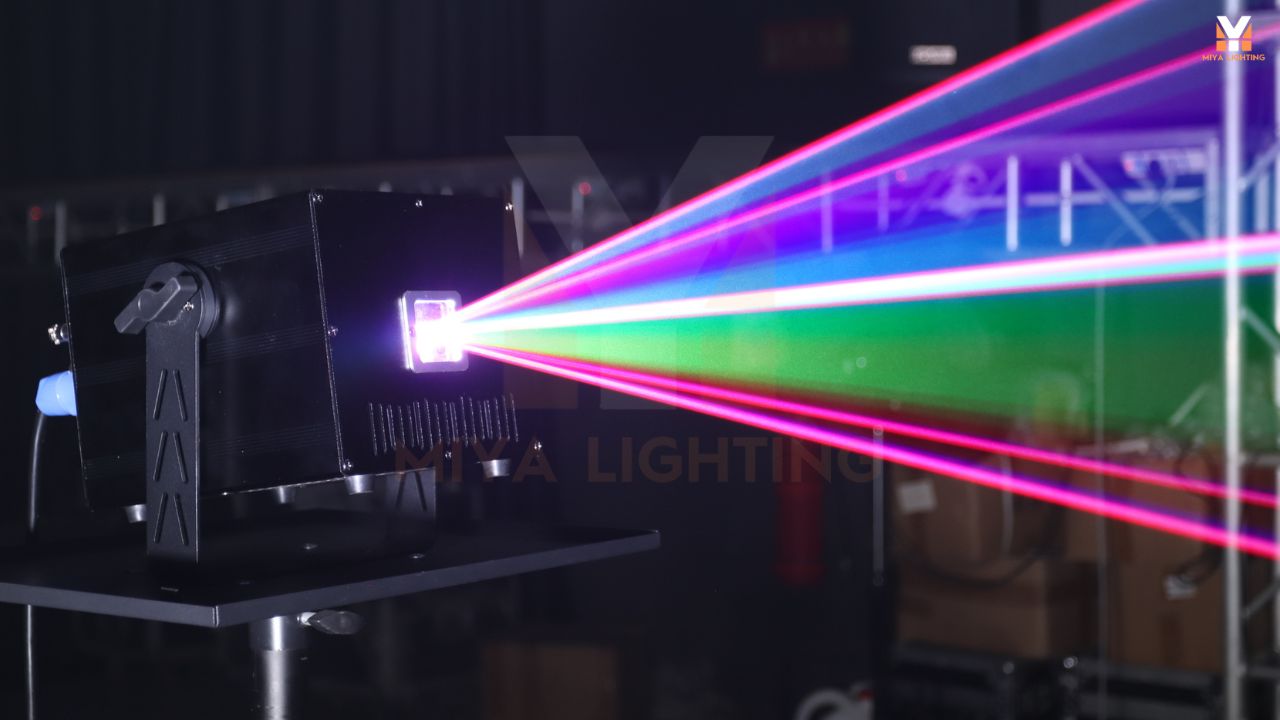
You’re standing at the front of the house or right in the middle of the crowd. The beat drops, the bass hits, and suddenly, massive beams of light slice the room entirely in half. It looks incredible. But if you're the one actually buying and programming the gear, you have to look past the hype. You need to understand the science of what laser light is and how the visual spectrum actually works.
If you are trying to upgrade your rig, you have probably fallen down the rabbit hole of laser colors. Let's cut through the marketing noise, debunk some major internet myths about power, and figure out exactly which beam is going to look the best at your next gig.
Let's Start Old School: Why Are Lasers Red?
Think of the classic 80s sci-fi aesthetic, a grocery store barcode scanner, or a cheap presentation pointer. Why are lasers red so often?
It really just boils down to manufacturing history. The very first working setups in the 1960s used synthetic ruby crystals, which naturally threw a deep red beam. Fast forward to today, and red lasers are simply the cheapest and easiest diodes to mass-produce. Because the tech is so old and reliable, red diodes form the baseline. That is exactly why almost every cheap, entry-level laser light toy relies heavily on a red diode.

Power vs. Brightness: What Color Laser is the Strongest?
Here is where the internet gets it twisted. Go on any gear forum, and you'll see people arguing over what color laser is the strongest or trying to figure out which laser color is the strongest for a specific stage setup. You have to separate electrical power (raw wattage and heat) from visual brightness (what your audience actually sees).
If we are talking strictly about raw, face-melting wattage—the hottest laser color and the absolute strongest laser color on the consumer market—blue takes the win. Modern manufacturing makes it incredibly cost-effective to push massive amounts of power through a blue diode (usually sitting around the 445nm to 450nm wavelength). If you ever see a sketchy YouTube video of a guy popping a balloon or lighting a match with a handheld pointer, it’s almost always blue.
But you aren't trying to light a campfire on stage. You want massive visual impact. And when it comes to the human eye, power doesn't always equal brightness.

The Heavyweight Match-Ups
Let’s run the classic color showdowns so you know exactly what you are paying for.
Blue Laser vs Green Laser This is the big one. So, is a blue laser stronger than a green one? On paper, yes. The blue diode is likely pushing more actual watts. But human eyes are weird. We evolved to be incredibly sensitive to green light (around 520nm). If you put a 1-watt green beam right next to a 1-watt blue beam in a hazy room, the green one will look massively brighter and more piercing to the crowd. When weighing a green laser vs a blue laser for a live gig, green is your undisputed visibility king, while blue gives you a heavy, saturated, atmospheric club vibe.
Blue Laser vs Red Laser In this fight, blue completely dominates. Standard red (around 650nm) often struggles to punch through the bright ambient glow of giant LED video walls and moving wash lights. Because blue diodes pack so much raw energy, the laser and blue color combination has become the absolute go-to for aggressive, heavy lighting at rock shows and EDM festivals. In a straight red laser vs. blue laser comparison, blue commands the room.

The Tactical Crossover
Interestingly, this debate isn't just for DJs and stagehands. We see this exact conversation happen in the tactical gear world. Guys are constantly arguing over a blue laser vs. a green laser for gun attachments or breaking down the pros and cons of red vs. green vs. blue laser sights.
Tactical shooters want a tiny dot they can track in broad daylight (where green usually beats red). Stage lighting guys want a thick, sweeping beam that cuts through dense fog. The physical environments are totally different, but the physics of how your eyes read those laser colors is exactly the same!

The Game Changer: The MIYA G1 and US Stock
So, if green is the brightest, blue is the strongest, and red is your reliable baseline, which one do you buy?
You don't. You buy them all.
When you run a laser on different colors, you are using a professional RGB projector. And right now, the absolute sweet spot for mobile DJs, touring bands, and venue owners is the MIYA G1 10W RGB Animation Laser Light.
The G1 houses high-powered Red, Green, and Blue diodes in one compact, tour-ready chassis. Using analog modulation, it mixes these three primary diodes to create millions of distinct shades—from icy cyan to hot pink to a brilliant, pure white. You get the blistering brightness of green, the raw power of blue, and the warm contrast of red, perfectly blended.
But here is the real reason the MIYA G1 is taking over rigs across the country: US Warehouse Stock.
There is nothing worse than dropping serious cash on a killer 10W rig for an upcoming gig, only to realize it's shipping from a factory overseas. You end up sweating bullets, refreshing a tracking number every morning for a month, just praying it clears customs before your show.
We killed that problem entirely. The MIYA G1 is fully stocked in our local US warehouses right now. What does that mean for you? Lightning-fast, free shipping directly to your front door anywhere in the States. No surprise import taxes, no customs holds, no BS. You order it, you get it fast, and you rig it.
Knowing the science behind the spectrum separates the pros from the amateurs. Stop guessing which beam will look best, and stop waiting months for your gear to arrive. Grab a MIYA G1 from our US stock, fire up the haze, and take total command of the room.

Leave a comment
This site is protected by hCaptcha and the hCaptcha Privacy Policy and Terms of Service apply.