
If you’re a mobile DJ, you probably know the routine: arrive at the venue, unload the speakers, set up the controller, position your DJ lights, and then start looking for outlets.
Sometimes they’re exactly where you need them. Sometimes they’re behind a table, across the dance floor, or already being used by the venue.
That means more extension cords, more power strips, more cable covers, and more time spent figuring out how to place your DJ laser lights without creating a mess.
This is where battery-powered laser lights start to make a lot of sense.
A rechargeable laser light won’t make your entire DJ setup wireless, but it gives you more freedom to put your laser where it actually works for the show—not just where the nearest outlet happens to be.
For mobile DJs, that can make setup faster, cleaner, and a lot less frustrating.
Why Mobile DJs Are Going Cordless
One extra cable doesn’t sound like much. But a typical DJ light show setup may already include moving heads, uplights, strobes, speakers, a controller, microphones, and haze equipment.
Every powered fixture adds another cable to route and another connection to manage.
At a wedding reception, your DJ booth might be on one side of the dance floor while the ideal position for your DJ laser light is somewhere else. A long extension cord can solve the problem, but now you have another cable that needs to be routed and secured.
A battery-powered DJ laser gives you another option.
Charge it before the gig, place it in an appropriate controlled position, and you’re no longer choosing fixture placement based only on outlet access.
For DJs who work different venues every weekend, that flexibility is one of the biggest advantages of portable laser lights.

Are Battery-Powered Laser Lights Powerful Enough?
This is usually the first question DJs ask when comparing rechargeable laser lights with conventional laser projectors.
The answer depends on the venue.
A portable laser isn’t automatically a low-powered party toy. Modern RGB laser lights can provide enough output for weddings, private parties, mobile DJ events, smaller clubs, and live performances.
But laser power is only part of the equation.
Room size, ambient lighting, projection distance, beam divergence, haze, and scanner performance all affect what the audience actually sees.
For a 100- to 150-person wedding reception, a compact portable DJ laser may make much more sense than carrying a large projector designed for a concert stage.
The goal isn’t to buy the most powerful laser. It’s to find the best DJ laser for the venues you actually work.
Battery Runtime Matters More Than You Think
When shopping for battery-powered laser lights, don’t look at laser output alone. Check the battery runtime too.
Think about how you use lighting during an event.
Your laser probably doesn’t need to run continuously from cocktail hour through the final song. Many DJs save stronger laser light effects for the dance portion of the night, especially during higher-energy tracks and drops.
A rechargeable laser with around two hours of battery operation can therefore be more practical than it sounds.
Keep the laser off during dinner. Bring it in when the dance floor opens. Use it selectively throughout the night.
This doesn’t just save battery—it can make your DJ laser show feel more dynamic because the effect doesn’t become visual background noise.

A Cleaner Wedding DJ Light Show Setup
Imagine you’re setting up in a hotel ballroom.
You already have two moving heads for movement, several wireless uplights around the room, your DJ controller and speakers, a strobe or effect light, and a haze machine where permitted.
Now you want to add laser lights.
With a conventional laser projector, you need to consider both the ideal projection position and the nearest power source.
With a battery-powered laser light, you have more freedom.
Position the fixture in an appropriate controlled location, secure it properly, and avoid adding another long power cable around the dance floor.
For mobile and wedding DJs who set up and tear down equipment several times a week, small improvements like this can make a big difference.
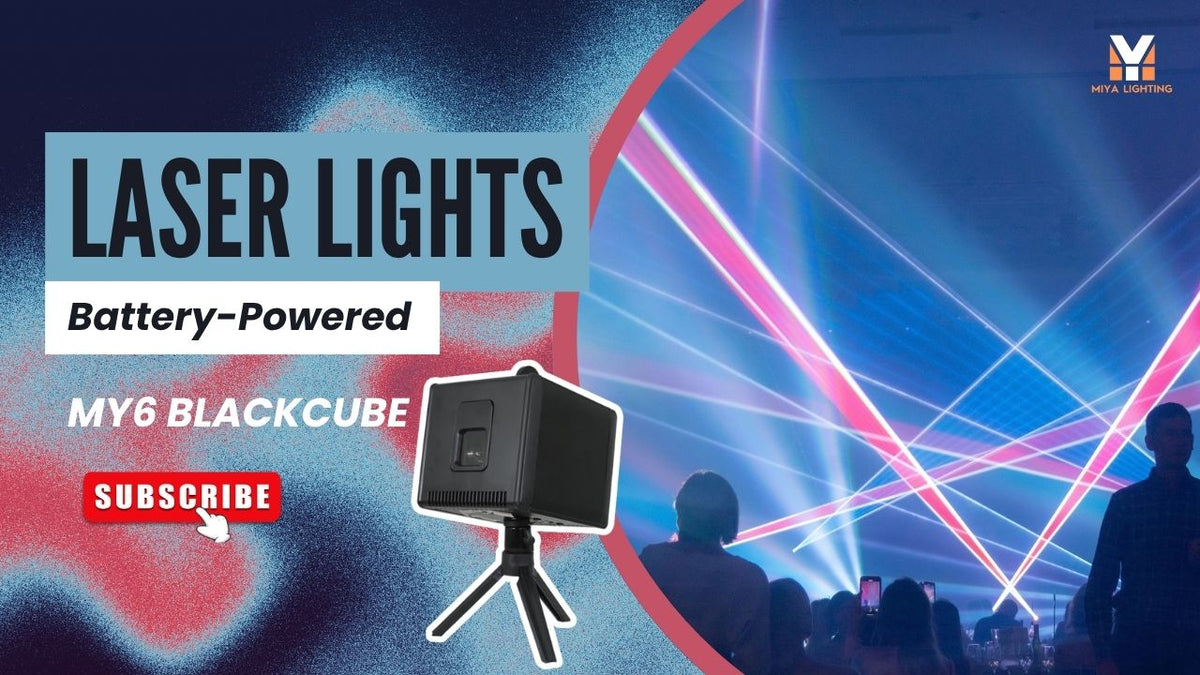
Meet the MIYA MY6 BlackCube
This is where the MIYA MY6 BlackCube fits naturally into a portable DJ setup.
Instead of putting a battery inside a basic party light, MIYA combines rechargeable operation with features normally associated with more capable professional DJ laser lights.
The MY6 is available with 3W or 5W full-color RGB laser output and a 25Kpps scanning system for geometric patterns, animations, and aerial laser effects.
Its built-in rechargeable battery provides around two hours of operation, making it practical for weddings, private parties, mobile DJ performances, and smaller live shows.
For DJs searching for portable laser lights for DJs, the biggest advantage isn’t one specification. It’s having output, scanning, battery power, and flexible control in one compact system.

Control Your DJ Laser from Your Phone
Not every mobile DJ wants to bring another laptop or lighting console to a small event.
With the MY6, you don’t have to.
The LightElf APP for iOS and Android lets you access built-in effects and operate the RGB laser projector directly from your phone.
For quick setups, you can also use Auto or Sound-Activated modes.
As your lighting rig grows, the MY6 supports DMX and ILDA control, giving you a clear upgrade path:
APP → Auto/Sound → DMX → ILDA
Start with phone control for a private party. Move to DMX when you want your laser DJ lights working with moving heads, strobes, and other stage lighting. Use ILDA when you’re ready for more advanced laser programming.
You don’t need to learn everything before your first gig.
Add Haze for a Bigger Laser Light Show
If you want visible laser beams in the air, haze can completely change the effect.
In clean air, you mainly see the laser when it reaches a surface. Fine haze particles scatter some of the light toward the audience, revealing the path of the beam.
That’s how club laser lights and EDM lasers create those sharp aerial fans, sheets, and tunnel-style effects.
You don’t need to fill the room with dense smoke. A light, even haze can make laser lights for DJs much more visible.
For surface projection, the MY6 can also display geometric and animation effects on suitable walls or projection areas.
Always check the venue’s haze and fire-alarm policies before the event.

Are There Downsides to Rechargeable Laser Lights?
Of course. Battery runtime is limited, so longer events may require charging between uses or switching to external power. A compact DJ laser also isn’t designed to replace the high-output show lasers used for large concerts, arenas, or outdoor festivals.
And battery power doesn’t change laser safety requirements.
The fixture still needs to be securely positioned, and laser output must be kept out of unsafe audience eyelines and uncontrolled areas. Always follow the manufacturer’s instructions and applicable laser safety requirements.
For large permanent installations, a conventional powered professional laser system may still make more sense.
Are Battery-Powered Laser Lights Worth It for DJs?
For many mobile DJs, yes. A battery-powered laser light can remove one more cable from your rig, give you greater freedom when choosing fixture placement, and help simplify setup at weddings, parties, and smaller live events.
The MIYA MY6 BlackCube takes that convenience further with 3W or 5W RGB output, 25Kpps scanning, rechargeable battery operation, smartphone APP control, built-in effects, DMX, and ILDA.
It isn’t trying to replace a festival-scale laser system.
It’s designed for DJs who need to load in, set up quickly, create a professional-looking DJ laser show, pack everything back into the car, and do it all again at the next gig.
If that sounds like your typical weekend, a rechargeable DJ laser isn’t just a cool upgrade. It may be one of the easiest ways to make your lighting setup more portable.


Leave a comment
This site is protected by hCaptcha and the hCaptcha Privacy Policy and Terms of Service apply.