
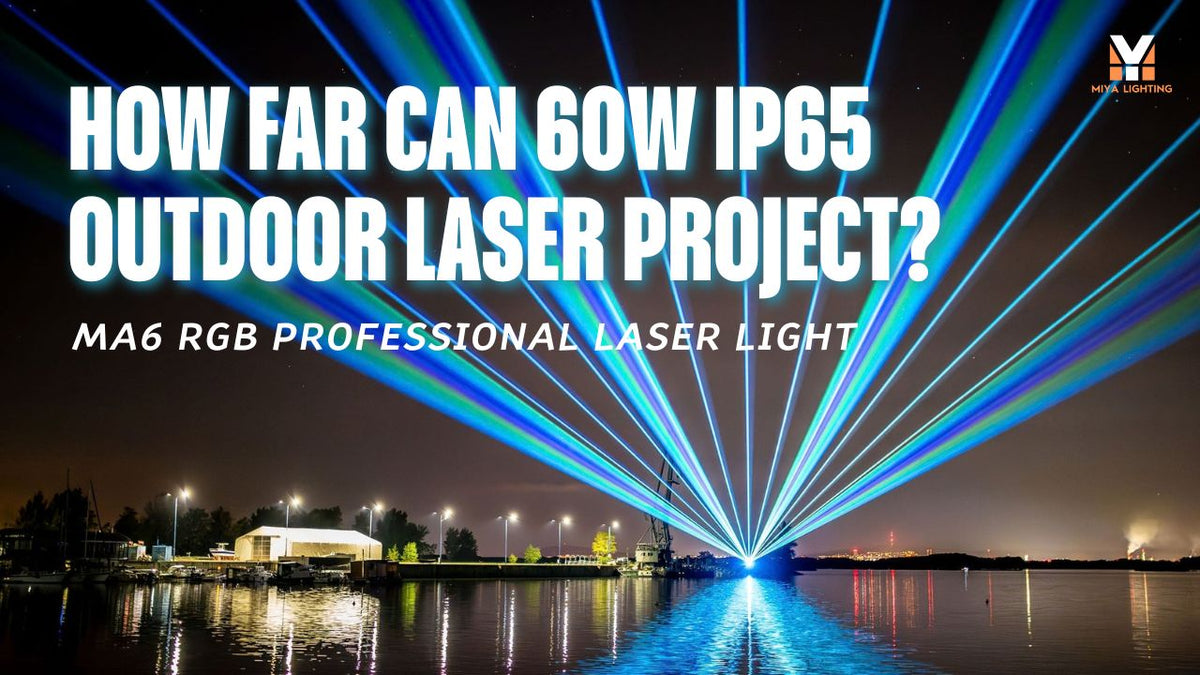
If you’re shopping for a professional outdoor laser light projector, one question usually comes up first: How far can a 60W laser actually project?
Search online and you’ll find similar questions: How far can a laser travel? How far can a laser go? How far can a laser beam travel?
Those questions sound simple, but there’s an important difference between how far laser light can physically travel and how far a laser show projector can produce a useful, visible effect.
There is no single “60W laser distance.”
Two 60W projectors can perform very differently at the same distance. Laser power matters, but so do beam divergence, ambient light, atmospheric conditions, target surface, graphics complexity, viewing angle, and the level of visibility you need.
So instead of asking only how far an outdoor laser projector can reach, ask: How well will the effect remain visible at the distance required for my show?
How Far Does a Laser Travel vs. How Far Can You Actually Use It?
This distinction matters.
When people ask how far does a laser travel or how far do lasers go, they’re often asking a physics question. Laser light doesn’t simply stop after a fixed number of feet or meters.
For professional entertainment, however, that isn’t the useful measurement.
What matters is the distance over which your high powered laser can create the intended visual effect with enough clarity and visibility for the audience.
A thin aerial beam against a dark background is very different from a detailed RGB animation projected onto a brightly lit building.
That’s why a professional laser light show system shouldn’t be evaluated by a single maximum-distance claim.

60W Tells You Power, Not Projection Distance
A 60W rating describes laser output. It doesn’t automatically define how far a programmable laser light projector will remain effective.
Imagine two outdoor productions.
One uses simple aerial beams across a dark festival environment. The other uses laser mapping and RGB graphics on an architectural façade surrounded by streetlights, LED screens, and illuminated windows.
Even if both use 60W projectors, the practical working conditions are completely different.
This is why claims such as “60W = 500 meters” can be misleading.
For professional laser outdoor lighting, wattage is only one part of the equation.
Beam Divergence Matters More as Distance Increases
One of the most important specifications to compare is beam divergence.
Beam divergence describes how quickly a laser beam expands as it travels. It is commonly measured in milliradians, or mrad.
A tighter beam generally expands more slowly.
That becomes increasingly important over longer distances because the beam doesn’t remain the same diameter after leaving the projector.
The MIYA MA6 60W outdoor laser projector, for example, specifies beam divergence below 1.2 mrad.
That number gives a professional buyer information that wattage alone cannot.
If you’re wondering how far can a laser reach while still maintaining the beam characteristics required for a show, output power and beam divergence need to be evaluated together.
This is particularly important for architectural projects, large outdoor productions, and long-throw visual effects.

Ambient Light Can Change the Result
A laser that looks extremely bright in one location may appear far less dominant somewhere else.
The reason is ambient light.
A dark outdoor festival field gives an outdoor laser show a very different background from a downtown building surrounded by signage, streetlights, and architectural lighting.
In darker environments, laser effects can appear much more prominent.
In a bright urban environment, your projector has more competing light to overcome.
That’s why professional laser light show equipment should be selected around the actual site—not just the wattage printed on the specification sheet.
Are You Creating Beams, Graphics, or Laser Mapping?
What you project matters just as much as how far you project it.
Simple aerial beams can create a strong visual impression because the output is concentrated into relatively simple lines, fans, and geometric structures.
Detailed graphics work differently.
When a programmable laser light projector draws a logo, text, or animation, its scanning system rapidly moves the beam through many points. As the image becomes more complex, the available visual energy is distributed across more of the image.
Laser mapping adds another layer because the projected content needs to work with the shape and structure of the target surface.
So asking: “How far can a 60W laser project?”
isn’t enough.
You also need to ask: “What am I trying to project at that distance?”
The MIYA MA6 uses a 30KPPS scanning system, giving it the ability to create programmed visual content in addition to high-impact beam effects.

Target Surface Matters for Building Projection
If your goal is architectural projection, study the building before choosing your laser show projector.
A lighter, relatively uniform surface can behave very differently from dark glass, windows, trees, reflective materials, or an irregular façade.
Projection angle also changes the result.
A projector positioned more directly toward a suitable target surface will produce a different visual result from one working at a steep angle.
This is why professional architectural laser mapping requires site planning.
A 60W MA6 provides substantial RGB output, but the building, distance, viewing angle, ambient light, and content still determine what the audience ultimately sees.
Atmospheric Conditions Affect Aerial Laser Beams
If you want the audience to see beams traveling through the air, atmospheric conditions become part of your laser light show system.
Fine airborne particles scatter some of the laser light toward viewers, helping reveal the beam path.
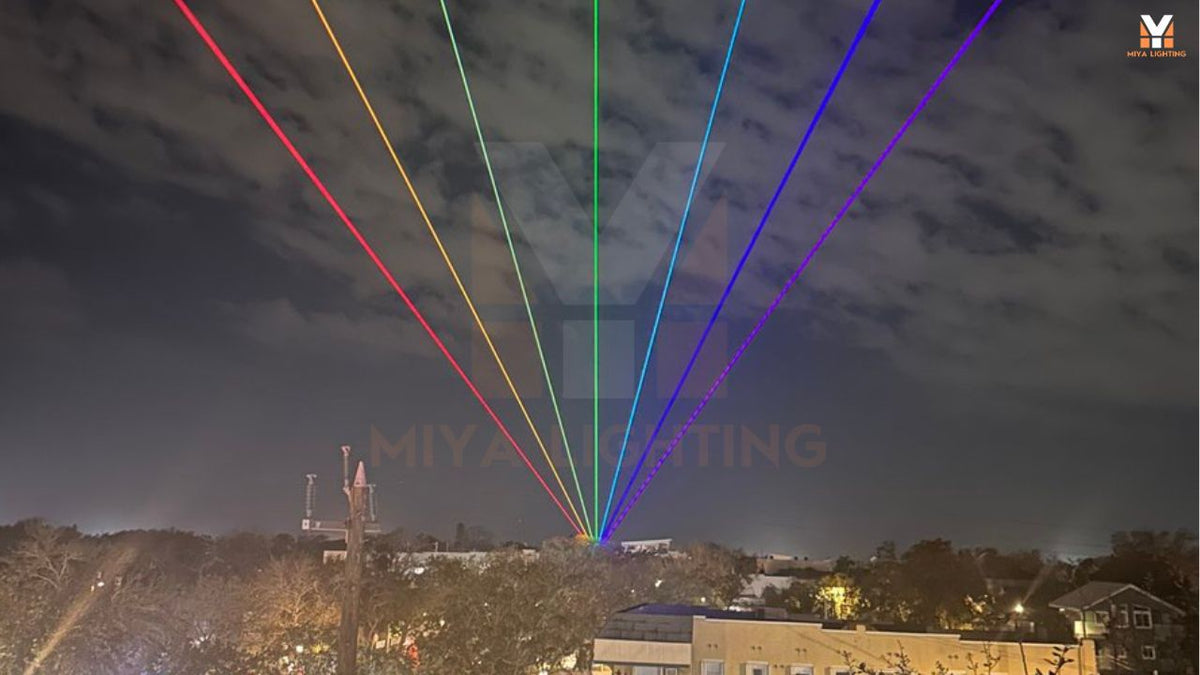
At a controlled concert stage, haze can make aerial fans, sheets, and tunnel effects much more visible.
Outdoor environments are less predictable.
Humidity, mist, dust, haze, and wind can change how an aerial effect appears from different viewing positions.
That’s another reason the question “How far can lasers travel?” doesn’t give you enough information to plan an outdoor show.
Physical travel and useful visual performance are two different things.

Why Viewing Angle Matters
The audience’s position matters too.
Laser beams become visible to viewers when light is scattered toward their eyes. Change the viewing position and the same aerial effect can look very different.
This becomes especially important for festivals, stadium productions, theme parks, and architectural shows where spectators may be spread across a large viewing area.
Professional show design therefore considers: Projector → Distance → Effect → Environment → Audience
rather than simply: 60W → Distance
Where the MIYA MA6 Fits
The MIYA MA6 is a good example of why a professional outdoor laser light projector should be evaluated as a complete system.
Its 60W configuration combines RGB output with <1.2 mrad beam divergence, so buyers can evaluate both output and beam characteristics.
It also features 30KPPS scanning and analog RGB modulation for full-color programmed effects, while DMX and ILDA support provide professional control options. An optional built-in FB4 configuration is available for more advanced show workflows.
And because demanding outdoor applications require more than optical performance, the MA6 uses an IP65 enclosure, giving buyers a waterproof laser light projector designed for outdoor operating environments.
These specifications work together.
That tells you much more than a simple claim such as: “60W = X meters.”
So, How Far Can a 60W Outdoor Laser Project?
There is no honest universal number.
First determine the distance required by your project. Then evaluate ambient light, target surface, atmospheric conditions, viewing angle, graphics complexity, and the effect you want the audience to see.
After that, compare laser power and beam divergence.
A professional outdoor laser projector such as the MIYA MA6 60W is built for demanding applications including concerts, large outdoor productions, theme parks, architectural displays, and controlled building projection.
But even with a high powered laser, the smartest question isn’t: “How far does the laser go?”
It’s: “At my required distance, under my actual conditions, can this laser create the effect I need?”
That’s the question that leads to the right outdoor laser show system.

Leave a comment
This site is protected by hCaptcha and the hCaptcha Privacy Policy and Terms of Service apply.