
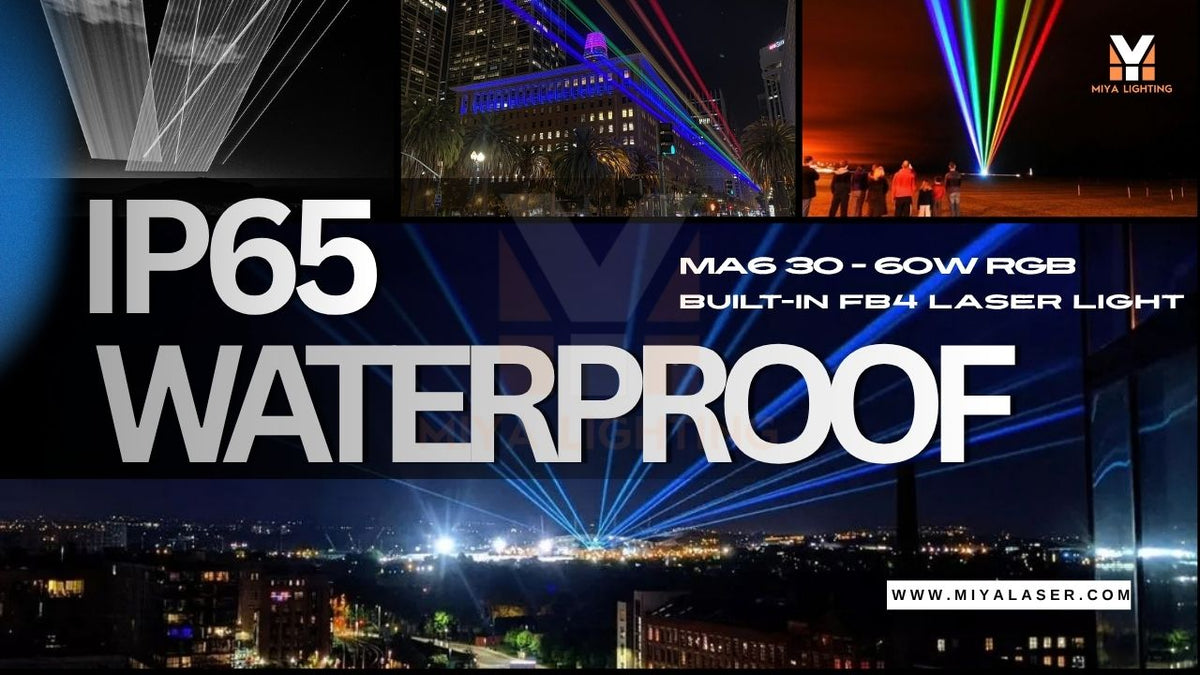
You’re setting up an outdoor laser show. The stage is ready, the projectors are in position, and the forecast looks clear.
Then the weather changes.
For concerts, festivals, theme parks, architectural displays, and other outdoor productions, that’s a real concern. A professional outdoor laser projector has to do more than create bright RGB effects—it also needs an enclosure designed for the environment around it.
That’s why you’ll often see terms like IP65 laser projector, waterproof laser, and weatherproof light when comparing outdoor equipment.
But what does IP65 actually mean? And does it make a waterproof laser light projector safe to use in the rain?
Here’s what to know before you buy.
What Does IP65 Mean?
IP stands for Ingress Protection. The two numbers describe how well an enclosure protects its internal components from solids and water.
With IP65:
6 means the enclosure provides a high level of protection against dust ingress.
5 means the enclosure is protected against water jets from different directions.
For an outdoor laser light projector, this is important. Outdoor equipment can be exposed to dust, moisture, splashing water, and changing weather conditions that a typical indoor laser light projector was never designed to handle.
An IP65 enclosure provides significantly better environmental protection.
But there’s one important point: IP65 does not mean the projector can be submerged in water.
Terms such as waterproof lights and waterproof laser lights are commonly used when people shop online, but IP65 is better understood as outdoor-rated protection rather than permission to use the equipment underwater.

Can an IP65 Laser Projector Be Used in Rain?
An IP65 enclosure is designed to protect against water jets, making an appropriately installed outdoor waterproof laser light projector far better suited to outdoor exposure than an indoor-only fixture.
That matters when you’re setting up an outdoor concert or festival and the weather changes halfway through the event.
The same applies to theme parks, architectural displays, touring productions, and temporary outdoor installations.
However, even with waterproof lighting, you still need to consider the complete installation.
Power connections, signal cables, mounting, drainage, ventilation, severe weather, and the manufacturer’s operating instructions all matter.
Think of IP65 as an important layer of protection—not a reason to ignore the weather.
Waterproof vs. Water Resistant vs. Weatherproof
These terms are often mixed together when people search for waterproof outdoor lights.
A water resistant light provides some level of protection against moisture, but the term by itself doesn’t tell you exactly how much.
“Waterproof” is commonly used in product searches, but it can sound more absolute than the actual IP rating.
“Weatherproof” generally describes equipment designed to handle outdoor environmental exposure, but again, you should always check the specific IP rating.
For professional laser equipment, the rating tells you more than the marketing word.
If you need a waterproof light for outdoor events, look for the actual IP specification and installation requirements instead of relying only on “waterproof” in the product title.

Indoor Laser vs. IP65 Outdoor Laser
If your laser show projector stays inside a nightclub, ballroom, or theater, an indoor enclosure may be completely appropriate.
Move that same projector outdoors and the situation changes.
Now you have dust, moisture, wind, temperature changes, and unpredictable weather.
An IP65 outdoor laser projector is designed to provide better protection against those conditions.
That makes this type of laser outdoor lighting especially useful for outdoor concerts, music festivals, theme parks, building projections, architectural shows, and other professional outdoor productions.
If outdoor shows are a regular part of your work, IP protection should be one of the first specifications you check.
Is IP65 the Only Thing That Matters?
No—and this is where buying an outdoor laser light projector gets more interesting.
Weather protection tells you whether the enclosure is suited to outdoor exposure. It doesn’t tell you whether the projector can actually create the show you have in mind.
You also need to look at laser power, beam divergence, scanning performance, color modulation, projection distance, and control options.
For example, a high powered laser may be needed for a large-scale professional production, but power alone doesn’t guarantee better graphics or animation.
If you want patterns and programmed visual content, scanner performance matters.
If you want smooth RGB color mixing, modulation matters.
And if you’re building a professional outdoor laser light show, control options such as DMX, ILDA, or FB4 can become just as important as raw output.

What Should You Look for in Outdoor Laser Show Equipment?
Start with the environment.
Will the projector be used indoors or outdoors? Is it a temporary event setup or part of a longer installation? How large is the projection area? How much ambient light is present?
Then consider the show itself.
A basic laser light machine and a professional laser light show projector are not necessarily designed for the same job.
Large events may require higher RGB output, tighter beam performance, faster scanning, and professional programming capabilities.
If you’re purchasing laser light show equipment for concerts, festivals, buildings, or attractions, look at the entire system rather than focusing on a single specification.
IP65 protects the projector.
The rest of the specifications determine what kind of show it can create.
How the MIYA MA6 Fits Outdoor Productions
The MIYA MA6 is built for professional outdoor laser applications where both performance and environmental protection matter.
It is available in 30W, 40W, 50W, and 60W RGB configurations, allowing buyers to choose output based on venue size, projection requirements, and the type of production.
The IP65-rated enclosure makes the MA6 suitable for outdoor environments, while 30KPPS scanning, analog RGB modulation, DMX and ILDA control, and optional FB4 integration provide the tools needed for more advanced laser shows.
That combination makes the MA6 a strong fit for professional events, theme parks, architectural displays, landmark projects, concerts, and large-scale outdoor laser lights applications.
Instead of choosing a projector simply because the product title says “waterproof,” you’re choosing an outdoor system designed around both protection and show performance.
Can an IP65 Laser Stay Outside Permanently?
Not automatically.
IP65 alone doesn’t mean every waterproof laser light projector is approved for permanent, unattended outdoor installation.
Long-term installations introduce additional factors such as temperature, drainage, ventilation, direct sunlight, mounting hardware, cable protection, and maintenance.
For permanent architectural installations, always follow the manufacturer’s installation requirements and applicable electrical and laser-safety requirements.
For temporary events, inspect the projector, connections, and mounting before each show.

Is an IP65 Laser Projector Worth It?
If all of your shows happen indoors, you may not need one.
But if you regularly work outdoors, an IP65 laser projector can make much more sense than trying to protect an indoor fixture every time the weather changes.
Just remember: IP65 is one part of the buying decision.
A professional waterproof laser should also match your required output, projection distance, scanning performance, control system, and show type.
The MIYA MA6 outdoor laser projector combines IP65 outdoor protection with 30W–60W RGB output and professional show-control options, giving event producers a system designed for more demanding outdoor productions.
Because a great outdoor laser light show needs more than powerful laser effects.
It needs equipment built for the environment where the show actually happens.

Leave a comment
This site is protected by hCaptcha and the hCaptcha Privacy Policy and Terms of Service apply.