
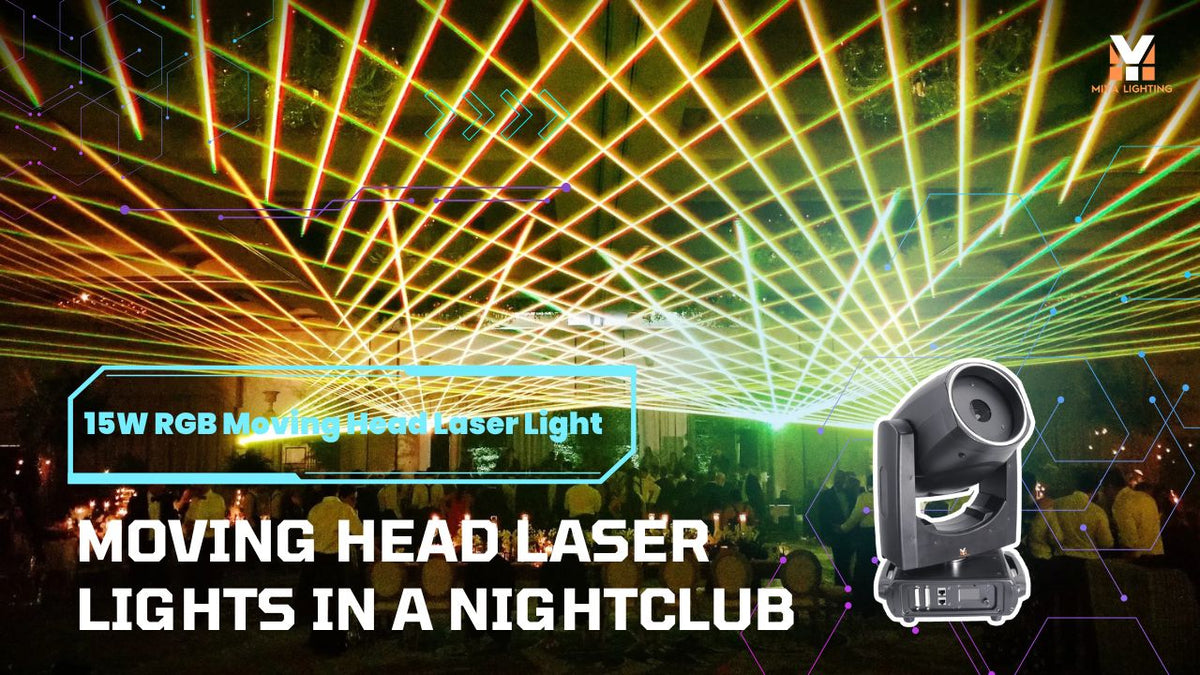
Great club lighting isn’t about filling the ceiling with as many fixtures as possible. The best nightclub rigs give every light a job: moving head lights build aerial structure, wash lights color the room, strobes punch through beat drops, and lasers add razor-sharp lines that conventional stage lights simply can’t create.
A moving head laser light brings those worlds together. You get the sharpness of a laser beam plus the physical movement of a moving head.
For nightclub owners, DJs, and lighting designers, the MIYA 15W RGB Moving Head Laser Light can add a completely different layer to a professional lighting rig—without replacing the fixtures you already use.
What Does a Moving Head Laser Add to Club Lighting?
A traditional laser projector can create impressive graphics, patterns, and aerial effects, but the projector itself normally stays aimed at a fixed projection zone.
A laser moving head light adds physical pan and tilt.
The MIYA 15W model combines internal 20Kpps laser scanning with 540° pan and 270° tilt. The scanner creates the pattern or laser beam, while the moving head changes where the complete effect is directed.
That means a moving laser light can add something different to a club:
laser sharpness + physical movement.
It doesn’t need to replace your traditional lasers or professional moving head lights. It works alongside them.

A Practical Nightclub Lighting Rig
For a medium-size nightclub or DJ venue, a balanced setup could look like this:
2 × Moving Head Lasers: Add sharp RGB laser movement and changing projection directions.
4 × Beam Moving Head Lights: Build strong aerial structure over the stage and dance floor.
Wash Lights: Fill walls, ceilings, and stage areas with color.
Strobes: Create high-impact flashes for drops and transitions.
Haze: Makes the paths of laser beams and conventional beams visible in the air.
The result is much more interesting than using six similar DJ moving head lights.
Each fixture contributes a different texture to the room.
Moving Head Laser vs. Beam Moving Head Light
A beam moving head light and a moving head laser may both pan and tilt, but their visual character is very different.
Conventional moving heads typically use LED or lamp sources to create beam, spot, or wash effects. Their beams have visual weight and are excellent for building large aerial shapes.
A laser produces a much sharper line.
That contrast is exactly why the two work so well together.
Imagine four moving heads stage lights opening into a wide fan behind the DJ booth. Between them, two MIYA moving lasers create thin RGB lines that sweep through the haze.
The beam fixtures provide the structure.
The lasers provide the precision.
Instead of asking which one is better, think about how they can complement each other.

Where Should Moving Head Lasers Go in a Nightclub?
For a symmetrical DJ setup, two moving head laser lights can be positioned on separate sides of the booth or installed on an appropriate lighting truss.
This gives the lighting designer the ability to create mirrored effects, opposing movements, and different controlled projection positions throughout the night.
Larger clubs can integrate additional units across the stage or lighting structure.
Whatever the layout, laser positioning should be planned intentionally. Professional laser systems require appropriate safety practices, controlled projection zones, and installation that prevents hazardous audience exposure.
The goal isn’t to send laser beams everywhere. It’s to create a deliberate show.
Use Haze to Make the Beams Come Alive
Haze is one of the most important ingredients in aerial club lighting.
Without particles in the air, you often see a laser most clearly when it reaches a surface. With controlled haze, the path of the beam becomes visible.
The same applies to moving head lights.
Suddenly, the space above the dance floor becomes part of the show. Thick moving-head beams create large aerial shapes while thinner laser beams cut through the same space.
This difference in beam texture gives a professional nightclub rig much more depth.

Build Different Looks Throughout the Night
A good nightclub show shouldn’t stay at maximum intensity from opening until closing.
Early in the evening, wash lights can carry most of the atmosphere while the moving lasers use slower effects.
As the room fills, introduce more moving lights and stronger aerial looks.
During a build-up, the beam moving heads can gradually reposition while the lasers create slower sweeping patterns.
Then comes the drop.
The strobes hit. The moving heads open. The RGB laser effects accelerate.
That contrast makes the big moments feel bigger.
APP Control for Smaller Clubs and DJs
Not every venue has a dedicated lighting operator.
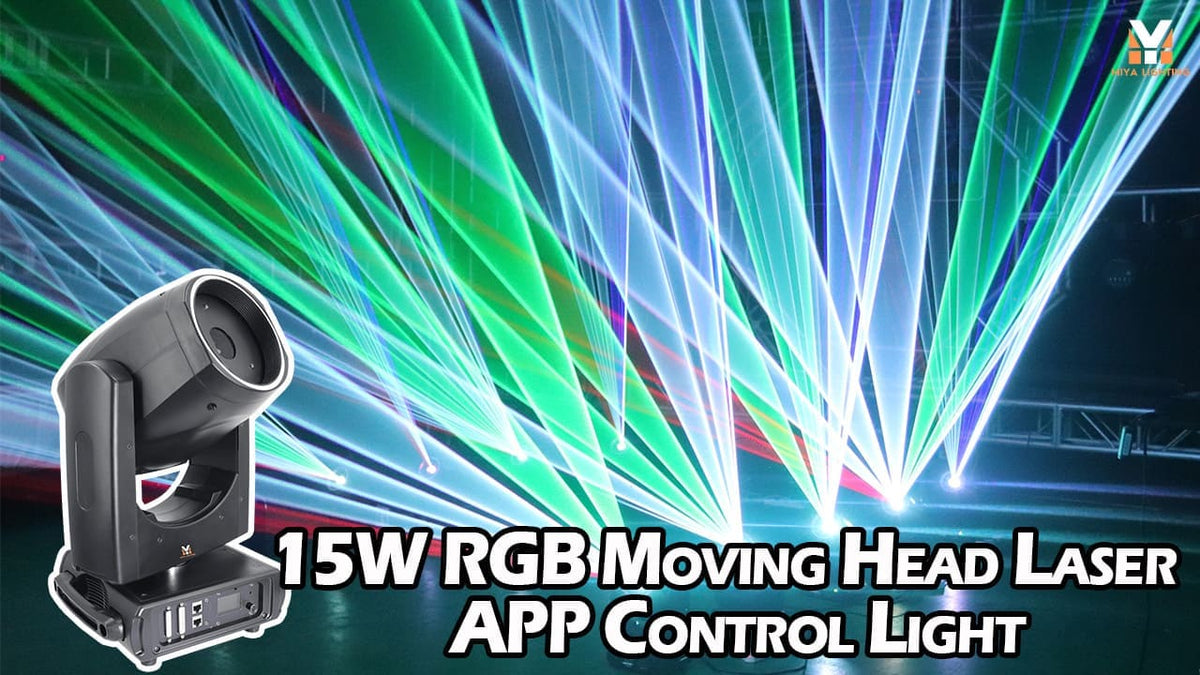
The MIYA 15W moving head laser offers APP control for iOS and Android, giving access to 300+ built-in effects. Users can adjust color, brightness, speed, strobe, rotation, and other effect settings from a phone.
For smaller clubs, mobile DJs, and event spaces, this makes it easier to start creating laser effects without immediately programming a full DMX system.
Sound Active and Auto modes provide additional options when you want more hands-off operation.

Use DMX for a Complete Club Lighting System
When your rig includes multiple DMX moving head lights, washes, strobes, and lasers, centralized control becomes much more important.
The MIYA moving laser supports DMX512, allowing it to become part of the same programmed lighting cues as the rest of the system.
A single cue might change the room color, reposition your moving head DJ lights, trigger a strobe, and switch the laser effect.
This is where a professional moving head laser light becomes much more than a standalone DJ laser.
It becomes part of the show design.
For more advanced laser programming, the MIYA also supports ILDA control, giving experienced operators another level of flexibility.
Do You Still Need Traditional Laser Projectors?
Absolutely. A moving laser light projector and a traditional fixed laser projector solve different problems.
If you want logos, animations, graphics, or effects aligned precisely with one projection surface, a traditional laser projector can be the better choice.
If you want the physical direction of the laser effect to change throughout the performance, the moving head design has the advantage.
A larger nightclub can use both.
Fixed projectors handle precisely positioned laser content, while moving head laser lights introduce changing directions and physical movement.

Is the MIYA 15W Moving Head Laser Right for Your Club?
The MIYA 15W RGB Moving Head Laser Light combines true 15W RGB output, analog modulation, 20Kpps scanning, 540° pan, 270° tilt, APP control, DMX512, ILDA, and 300+ built-in effects.
But its real value isn’t simply the specification sheet.
It’s the role it can play between your traditional lasers and professional moving head lights.
Use moving heads for powerful aerial structure. Use washes for room color. Use strobes for impact. Use haze to reveal the beams.
Then add the moving head laser for something different: the sharpness of laser light with the freedom of physical movement.
That extra layer can turn a collection of club lights into a lighting show that feels designed for the room.


Leave a comment
This site is protected by hCaptcha and the hCaptcha Privacy Policy and Terms of Service apply.