
If you have ever shopped for stage lighting, you have probably stared at the spec sheets and wondered, "What do I actually need to respect in terms of laser output power?"
You see a cheap 5W projector and a 10W laser pointer online, and somehow the 10W unit is barely more expensive. It’s incredibly tempting to just buy the bigger number. What exactly determines the power of a laser, and why is that shockingly cheap "high wattage" unit a total trap? In the professional live production world, raw laser wattage is only half the story.
If you want beams that actually look bright, crisp, and professional, here is the simple truth about laser power—without the confusing tech jargon.
1. Decoding the Numbers: What Are Lasers Measured In?
Before you buy a new rig, you have to understand the basic specs. People constantly ask on lighting gear forums, "What are lasers measured in?"
Generally, laser power is expressed as watts (W) or milliwatts (mW). These standard laser power measurement units help you gauge the overall capacity of the machine. For beginners trying to figure out the MW laser meaning, the math is simple: 1000 milliwatts equals 1 watt.
But when comparing fixtures, do not just look at the raw number on the box. You need to look for the "effective" laser output power.
What is the difference? Raw laser power is what the internal high-power laser diode produces inside the chassis. But before that laser energy actually leaves the box, it bounces off internal mirrors and passes through lenses. Cheaply made projectors lose a massive amount of optical power during this process because their internal glass is garbage.
Effective laser output is the actual energy measured right at the exit window (the aperture). It is the true power of laser light that actually hits your crowd. At MIYA, we use premium, high-reflectivity optics to ensure that the effective output matches exactly what you pay for.

2. The "Balanced White Light" Rule
Most modern laser power systems are RGB (Red, Green, Blue). To get a pure, balanced white light, the laser output of these three primary colors needs to be mixed perfectly.
Here is the catch: Human eyes see green light much better than red or blue. Some brands will sell you a "high-power laser" that is packed with 8 watts of green and very little red or blue. Sure, the overall laser parameters technically equal 10 Watts. But the moment you try to mix a clean, balanced white light in your software, you have to drastically dim that green module down so it doesn't wash out everything else.
When you dim that green diode, your massive 10W system is suddenly only putting out 4 or 5 watts of effective laser output power. Different laser powers are required for different venues, but a heavily mismatched RGB ratio guarantees you are wasting your money. You want a system where the laser power is harmonized across all three colors.

3. Wavelengths: The Ultimate Secret to Brightness
This is what separates the pros from the amateurs. Not all colors are created equal.
In the industrial manufacturing world, engineers use a specific peak power formula to calculate laser peak power so they can cut through solid steel. But stage lighting isn't about burning metal; it's about visual impact. A perfectly tuned system utilizing high-end diodes will easily outshine a sloppy system using cheap components, maximizing your laser energy density without needing a bigger power supply.
This comes down to exact nanometer (nm) wavelengths. For example, a red diode rated at 638 nm will look nearly twice as bright to your audience as an older, cheaper 650 nm red diode—even if they have the exact same laser wattage! Using the right wavelengths gives you "free" visual brightness.

Meet the 10W MIYA G1: Built for the Pros, Ready to Ship
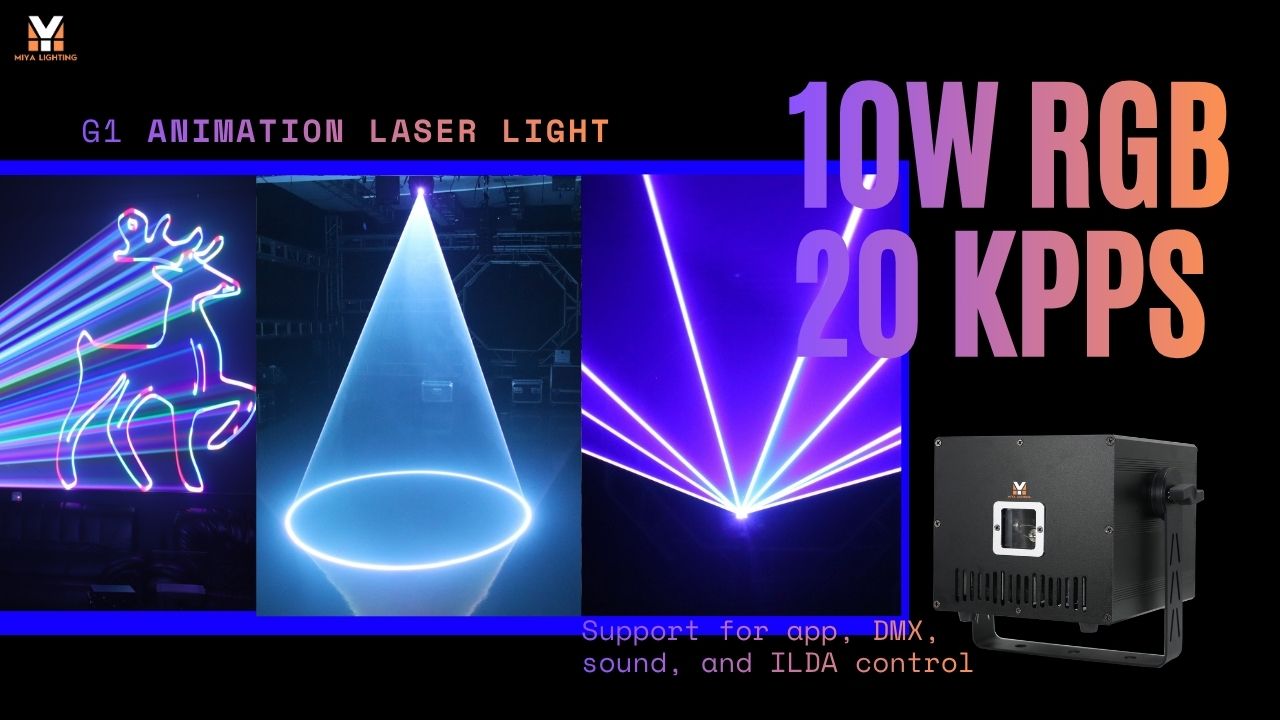
If you want a fixture that respects all of these optical rules, you need to look at the MIYA G1 RGB Animation Laser. The G1 isn't a toy, and it isn't an entry-level scalable unit. It is a dedicated, unapologetic 10W high-power laser built for serious touring rigs, massive clubs, and outdoor festivals. Here is exactly what makes the G1 the ultimate tool for your next show:
The Perfect Wavelength Trio: We didn't cut corners on our diodes. The G1 is meticulously engineered with the absolute best wavelengths for human visibility: Red: 638±5 nm, Green: 520±5 nm, Blue: 450±5 nm. This specific combination means your laser power systems are punching with maximum visual brightness and delivering a flawless, balanced white light.
Massive 10W Output: This is a true 10W beast. It has the raw laser output required to slice through heavy fog, dominate LED video walls, and fill massive outdoor spaces with ease.
US/Overseas Warehouse In-Stock: There is nothing worse than dropping cash on a professional rig and waiting two months for it to clear customs. The MIYA G1 is fully stocked in our overseas warehouses right now. No massive import taxes, no customs holds, no BS. You order it, we ship it fast, and you rig it up.
App-Based Creative Control: You don't need a heavy lighting console to get started. Control text, project logos, and trigger custom drawings directly from your smartphone using the LightElf app (iOS and Android). Adjust your laser parameters and edit in real-time.
Smooth 20K PPS Scanning: Raw laser energy is useless if your graphics look choppy. The G1 features a built-in 20K PPS high-speed scanning system, ensuring that every custom animation stays razor-sharp and buttery smooth.
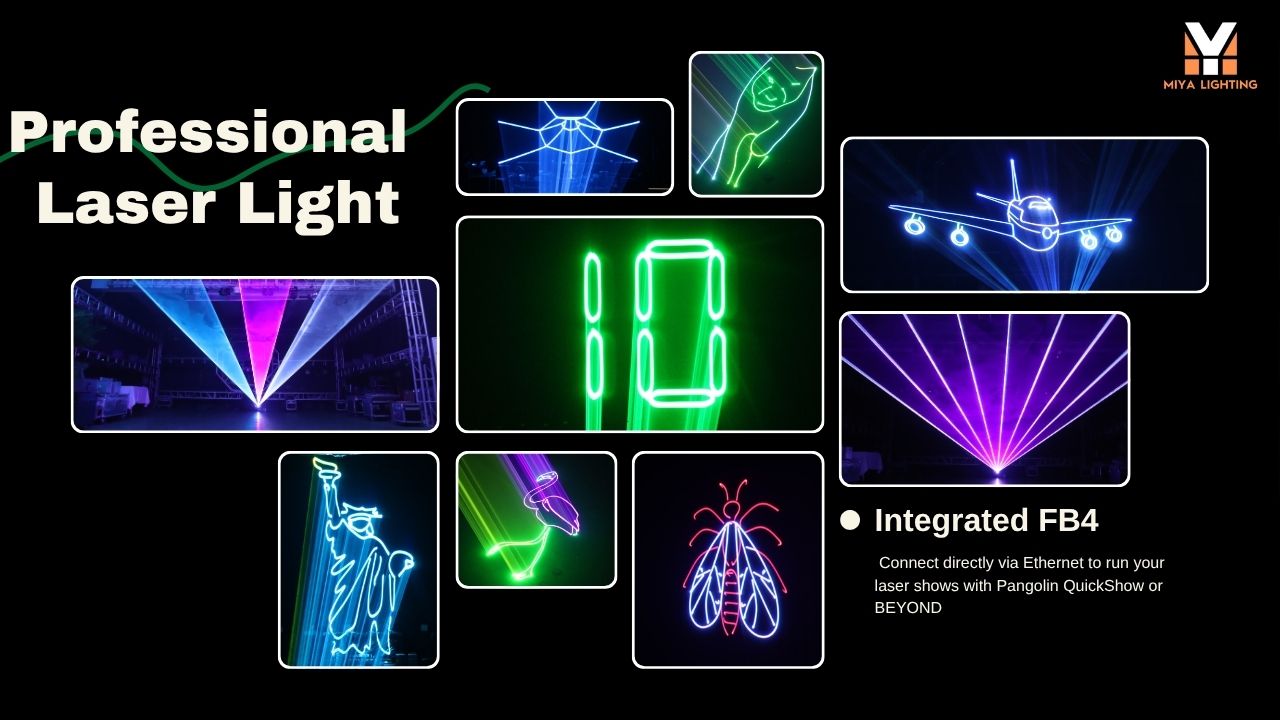
Professional ILDA Compatibility: When you are ready to take the training wheels off, the G1 is fully compatible with industry-heavyweight software like Pangolin QuickShow and BEYOND (FB3/FB4).

The Bottom Line
Stop chasing the biggest number on the cheapest spec sheet. When shopping for your next rig, respect the optics, demand honest, effective output, and absolutely check the wavelengths. Upgrade to the 10W MIYA G1 today, get it shipped fast from our local warehouses, and let your audience see the true difference!

Leave a comment
This site is protected by hCaptcha and the hCaptcha Privacy Policy and Terms of Service apply.