
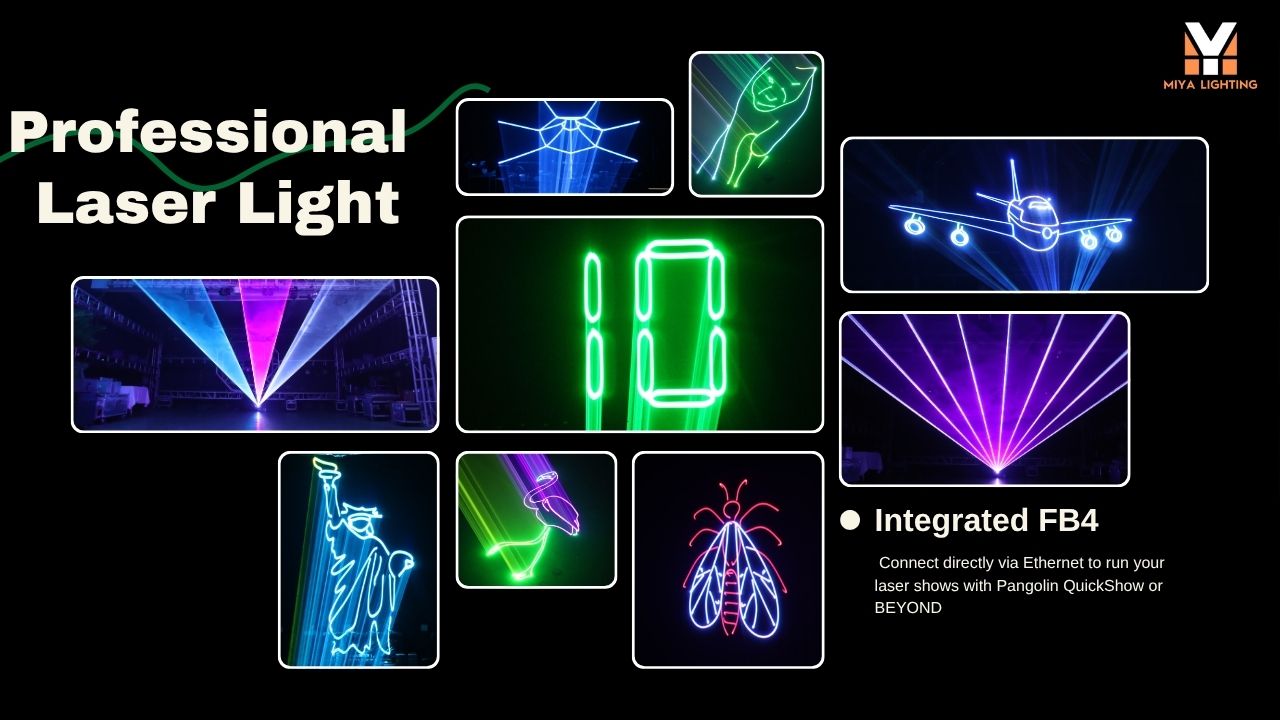
If you are building a new rig for a nightclub, gathering dj equipment for a mobile tour, or planning massive event lighting for an outdoor stage, you have probably looked at the price tags on professional gear and winced. Standard stage lights, basic dj lights, and simple bar lights have gotten incredibly cheap over the last few years. But then you click over to the laser category to find a true laser light show projector, and the prices suddenly jump.
It is easily the most common question we hear in the live production world: why is a professional stage laser projector so expensive compared to regular stage lighting?
When you look at a metal box that shoots light, it can be hard to justify spending thousands of dollars. But to understand the price tag, we have to look past the marketing hype, open up the chassis, and talk about the raw physics of what is actually happening inside these fixtures.
The Ultimate Plot Twist: They Actually Aren't Expensive
Before we break down the manufacturing costs, let’s get a massive historical reality check out of the way. If you are constantly wondering why your new dj laser costs more than basic disco lights for party setups, you probably weren't buying production gear a decade ago.
Here is the wild truth: the hardware for a massive lasershow is actually cheaper right now than it has ever been in human history.
About 10 years ago, if you wanted a true 5W RGB unit for professional concert lighting or heavy-duty club lighting, prices were at a minimum of 100,000 Euros (well over $100,000 USD). And that was just the starting range. Furthermore, those older units were absolute nightmares to operate. They were the size of refrigerators, they were entirely water-cooled, and they needed huge, dedicated three-phase power supplies just to turn on.
Today, you can buy a powerful light show projector that fits in a pelican case, runs entirely on air cooling, and plugs into a standard 120V wall outlet—for a fraction of a fraction of that old price. So, while they might seem pricey compared to cheap disco lights, professional units are incredibly affordable nowadays.

You Aren't Buying a Lightbulb; You Are Buying Precision Optics
So, if prices have crashed that hard, what exactly are you paying for when you buy a modern system today? Why do they still cost more than a traditional stage light or standard theater lights?
It comes down to the light source. Budget fixtures or cheap party laser lights use very basic LED chips or low-quality diodes. A professional dj laser uses precision-engineered optical modules with strict analog color modulation.
Inside the housing, red, green, and blue beams have to be perfectly combined using microscopic dichroic mirrors. If a single internal mirror is off by a fraction of a millimeter, your colors separate, and your beam looks terrible. This level of optical alignment requires sterile manufacturing cleanrooms, highly skilled technicians, and extreme quality control. You are paying for laboratory-grade alignment.

The Magic of Moving Parts: High-Speed Scanners
When people ask why these units cost more than standard dj lighting, they usually forget that these machines are literally drawing complex animations in thin air to create a true laser light show.
To draw a shape, the beam bounces off two tiny mirrors connected to ultra-fast motors called galvanometers (or "galvos"). These galvos have to move at terrifying speeds. Not only do they have to move fast, but they also have to stop on a dime with surgical precision to draw sharp text and crisp logos without trailing light.
Manufacturing motors that can survive vibrating 30,000 to 40,000 times a second for a five-hour gig without melting is incredibly expensive. Cheap knockoffs use garbage scanners that make your animations look jittery. Premium gear costs more because it uses heavy-duty galvos that refuse to quit, whether you are running festival lasers at a rave or doing corporate gigs.

Thermal Management & Armor: Heat is the Enemy
If there is one thing you need to know about high-power diodes, it is that heat is their absolute worst enemy. Pushing raw optical power generates a massive amount of internal heat. If you don't cool the system perfectly, the diodes will literally cook themselves.
You are paying for advanced thermal management and environmental protection. Premium concert lights and outdoor fixtures are built with heavy-duty, sealed housings. You aren't just paying for the light; you are paying for the rugged armor that keeps that light alive in the rain, dust, and heat.

Safety and Legal Compliance
You cannot talk about the cost of high-end equipment without talking about the law. Whether you are running a local club gig or trying to pull off an outdoor spectacle on the scale of the famous stone mountain light show, shooting high-powered beams over a live crowd requires serious safety mechanisms.
Professional fixtures must include features like auto-shutoff sensors and beam protection. Developing, testing, and certifying these safety systems costs manufacturers a massive amount of money. When you buy a cheap knockoff, you are taking on a massive liability risk. The higher price tag of a legitimate fixture is literally buying you peace of mind.

The Proof of Value: The MIYA MY5-F Series
At MIYA, we completely understand the sticker shock. We know exactly why upgrading your dj laser lights can hurt the wallet. But to truly understand the insane value of modern professional gear, let's look at a real-world case study: the MIYA MY5-F Series (MY-SF5).
Priced at $3,503.00, the MY5-F is a high-power 18W RGB projector (maxing out in the 20W class). Ten years ago, a 20W laser would have cost as much as a luxury sports car. Today, for roughly the price of a high-end laptop, you are getting an absolute powerhouse designed specifically for large-scale shows and permanent installations.

Here is exactly where every dollar of that $3,503 goes:
The Brain (Built-in FB4): You don't have to buy external networking hardware. The MY5-F integrates the industry-standard Pangolin FB4 directly into the unit. It offers an RJ45 ILDA / DMX512 control interface that seamlessly plays nice with Pangolin, MA, Tiger, and Pearl controllers.
Surgical Optics & Power: You are getting imported semiconductor solid-state lasers producing exact, highly visible wavelengths (Red 638nm, Green 520nm, Blue 455nm) with full analog modulation. It delivers ultra-sharp beams with less than 1.2 mrad divergence. That means the beam stays tight and blindingly bright even across massive outdoor festival grounds.
Elite Scanning: Remember the expensive galvo motors we talked about? This unit is packed with a 35-40 KPPS high-speed scanning system. Your graphics, text, and aerial effects will be buttery smooth and flawlessly accurate.
IP65 Waterproof Housing: The MY5-F isn't just powerful; it is an absolute tank. It features an IP65 waterproof rating, meaning you can rig it up for an outdoor festival in a rainstorm, and the show will go on without frying the Max 350W power supply.
Built-in Safety: It comes standard with one-beam protection and an automatic shutoff feature if the control signal is lost, protecting both your audience and your investment.
The next time you look at a gear catalog, remember what is actually hidden inside that metal box. You are buying microscopic optical alignment, motors vibrating at 40,000 times a second, military-grade thermal management, and strict legal safety compliance. Stop wasting your budget on cheap toys that break after three gigs. Invest in the right gear, grab the MIYA MY5-F, and take total command of your next show.

Leave a comment
This site is protected by hCaptcha and the hCaptcha Privacy Policy and Terms of Service apply.