
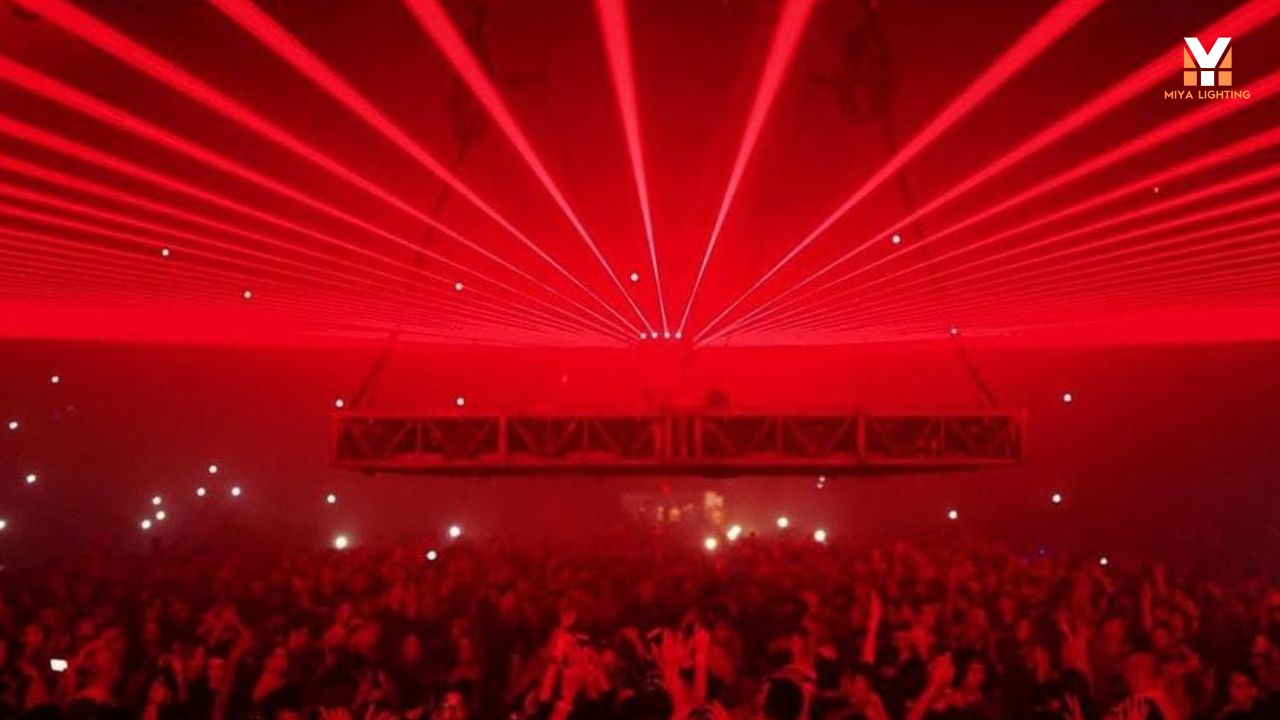
If you’ve ever seen a row of sharp laser beams spread across a nightclub or stage like a glowing fan, there’s a good chance you were looking at a laser beam bar.
Unlike a traditional laser projector that sends effects from a single output point, a laser bar uses multiple laser apertures arranged across a long fixture. This creates a much wider visual field and makes it possible to produce dramatic fan effects, chase patterns, and sweeping aerial beams.
For DJs, clubs, live bands, and event spaces, a laser light bar can add a completely different layer to the lighting rig.
The MIYA MR850 8-Eye Laser Beam Bar is a good example of this format. With eight separate 500mW red laser outputs, 240° Y-axis scanning, DMX control, and built-in effects, it is designed to create wide, high-impact beam looks without needing a traditional graphics projector.
What Is a Laser Beam Bar?
A laser beam bar is a stage lighting fixture that combines multiple laser sources in one long housing.
Each output creates its own visible laser beam, allowing several beams to appear at the same time.
Instead of relying on one aperture to create a single projection field, a multi-beam laser bar spreads the effect across a wider horizontal area. This makes it especially useful for aerial effects, fan patterns, rhythmic chases, and large visual sweeps.
The MR850 uses eight separate red laser outputs positioned across the bar, so the beams can work together as one wide effect rather than looking like a single point of light.
This gives the fixture the strong visual character of a beam light bar, but with the sharpness and intensity that only laser can provide.

How Is a Laser Bar Different from a Laser Projector?
A traditional laser projector and a laser bar can both create impressive effects, but they are designed for different visual goals.
A laser projector usually has one projection aperture and an internal scanning system that creates graphics, patterns, text, animations, or aerial effects.
A laser light bar, on the other hand, is built around multiple visible beam outputs.
That means a projector is usually better when you want detailed graphics or animated content, while a beam bar laser light is ideal when you want wide fan shapes, layered beam effects, and strong stage movement.
Think of it this way:
- A laser projector creates images and patterns.
- A laser beam bar creates space.
It fills a wider section of the stage or dance floor with multiple lines of light at once.
Why Multiple Laser Beams Matter
One laser beam can look powerful.
Eight beams can completely change the scale of the effect.
With multiple laser outputs, the light no longer feels like it is coming from a single source. Instead, the beams create a structured pattern across the venue.
This is especially effective in haze or fog, where each beam becomes clearly visible in the air.
Multiple beams can be programmed to open outward, move together, create chase sequences, or form a wide fan.
For DJs and stage designers, this makes a laser beam light useful for music-driven shows because the visual effect can expand and contract with the rhythm.
The more controlled the beam movement, the larger and more dynamic the stage can feel.

How Eight Beams Create a Wider Fan Effect
The fan effect is one of the main reasons people choose a multi-beam laser bar.
The MIYA MR850 uses eight separate red laser outputs arranged across the fixture. When the beams move together, they can spread outward into a wide fan shape that looks much larger than the fixture itself.
Its 240° Y-axis scanning gives the beams additional movement instead of keeping them fixed in one direction.
That means the effect can tilt, sweep, and shift throughout the show.
In a club, the beams can move over a controlled projection zone behind or above the dance floor. On a stage, they can create a wide visual background behind performers.
This combination of multiple apertures and scanning movement is what makes a stage light laser bar so visually different from a standard fixed light bar.
Fine Beam vs. Coarse Beam
Beam thickness has a big impact on the overall look.
A fine beam creates a sharper, thinner line. It can feel more precise and technical, especially when several beams are spaced evenly across the stage.
A coarse or thicker beam creates more visual weight. In haze, it can feel denser and more dramatic.
Neither option is automatically better.
Fine beams work well when you want crisp, clean lines.
Coarse beams can be a better choice when you want a stronger visual presence in a club or live event.
Choosing between the two depends on the atmosphere you want to create.

Why Haze Makes Laser Beams More Visible
Laser beams are easiest to see when there are particles in the air.
That’s why clubs, concerts, and stage productions often use haze or fog.
Without haze, you mainly see the beam when it hits a surface. With haze in the air, the entire path of the beam becomes visible.
This makes a laser beam light feel more three-dimensional.
A row of eight red beams can suddenly look like a glowing structure suspended in the air.
For a laser light bar, haze is often what turns a simple lighting effect into a full stage moment.
DJ Setup Example
For a mobile DJ, the MR850 can be positioned behind or above the DJ booth and combined with moving heads, strobes, and wash lights.
The moving heads handle color, movement, and broader beam effects.
The laser beam bar adds sharp red lines and fan patterns.
During slower parts of a set, the beams can move gradually or run simple chase effects. When the energy increases, faster movement and wider fan effects can make the room feel much bigger.
Because the MR850 supports Sound Active, Auto, Master-Slave, and DMX512 control, DJs can choose a simple setup or integrate it into a more advanced lighting rig.
Nightclub Example
In a nightclub, a multi-beam laser bar can become one of the main visual elements above the dance floor.
Mounted in a controlled position, it can create wide fan effects through haze and add movement between other club lighting fixtures.
A typical setup could include:
moving head lights for motion and color,
strobes for high-impact moments,
wash lights for ambient color,
and the laser light bar for sharp aerial beam effects.
Each fixture has a different job, and the result feels more layered than using several lights that all create the same type of effect.
Live Band Example
For a live band or small concert stage, the MR850 can create a strong visual background without needing complex graphics.
The eight red beams can frame performers, create fan effects behind the band, or move during key parts of a song.
Because it is a multi-beam fixture, one unit can create a wider visual impression than a single fixed beam light.
This makes it useful for rock shows, electronic performances, tribute bands, and indoor event stages where the lighting needs to feel energetic but not overly complicated.

How to Choose a Laser Beam Bar
When comparing laser bars, don’t look at power alone.
Consider the number of laser outputs, beam style, scanning range, control options, and the type of effects you actually want to create.
For professional DJ and stage use, DMX support is especially valuable because it allows the fixture to work with the rest of your lighting system.
You should also think about whether you prefer fine or coarse beams, how large the venue is, and whether you plan to use haze.
The MIYA MR850 combines eight 500mW red laser outputs, 240° scanning, multiple control modes, and built-in programs in one long-form laser beam bar.
For DJs, clubs, and live stages that want wide fan effects and sharp aerial beams instead of graphics and animation, that makes it a very different tool from a standard laser projector.
It doesn’t just add more light.
It adds more width, more movement, and more structure to the show.

Leave a comment
This site is protected by hCaptcha and the hCaptcha Privacy Policy and Terms of Service apply.